Technology for Automotive & Mobility

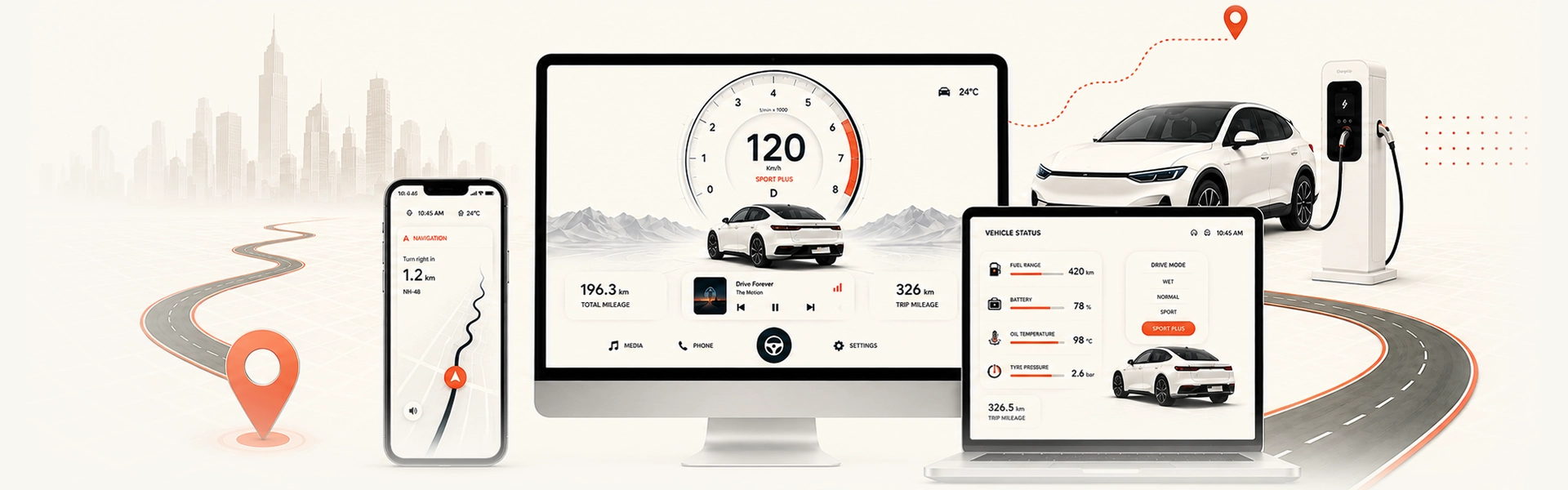
Automotive software doesn't get second chances. A fleet tracking system that drops data, an EV charging app that crashes mid-session, or a connected vehicle dashboard that lags at the wrong moment. We build the software behind mobility products that has to work every time, not most of the time.

AUTOMOTIVE & MOBILITY CAPABILITIES

Automotive software runs in conditions most development teams never plan for.

Spotty connectivity. Hardware you don't control. Users who can't stop what they're doing to deal with an error. We've built for those conditions across fleet management, EV infrastructure, connected vehicles, and mobility platforms. Here's what that looks like in practice.

Fleet Management Platforms

Fleet Management Platforms

Real-time tracking, route optimization, driver behaviour monitoring, and maintenance scheduling. Built for fleets that operate around the clock and operations teams who need accurate data every minute of every shift, not summaries the next morning.

Learn more
PLATFORMS WE WORK WITH

Automotive runs on specific protocols. Knowing them before the project saves everyone time.

MQTT for real-time telemetry. OCPP for EV charging. GPS and mapping APIs for anything that moves. These aren't technologies we learn on your project. They're part of how we scope and build from day one.

MQTT
MQTT & IoT Protocols
GPS
GPS & Telematics APIs
G
Google Maps Platform
EV
OCPP (EV Charging)
iOS
iOS & Android
Cloud
Cloud (AWS / GCP)

Our Process

We map the data flows, the hardware dependencies, the connectivity scenarios, and the failure modes before designing anything. A fleet tracking system that looks right in a wireframe but drops data on a rural route isn't ready. We find those gaps before the build starts.

Discover
ONBOARDING
DISCOVERY
Discover
ONBOARDING
DISCOVERY
WHY OCEAN

Mobility software fails in the field. We build to make sure yours doesn't.

General software agencies can build the interface. The hard part is the real-time data pipelines, the protocol integrations, the offline resilience, and the field behaviour that separates a demo from a deployment. Here's where we focus.

REASON 01

We build for connectivity gaps, not ideal conditions.

Every automotive system we build is designed to handle intermittent signal, queue data when offline, and sync cleanly when connectivity returns. Because rural routes, underground car parks, and dead zones exist whether you plan for them or not.

REASON 03

Real-time means real-time. Not near real-time.

Fleet tracking, EV session monitoring, and connected vehicle dashboards process data in milliseconds. We architect for that latency requirement from day one, not optimize for it after the system is already in production.

REASON 04

Field tested, not just lab tested.

We test on real hardware in real conditions before anything goes live. Signal drops, hardware reboots, and concurrent load on actual devices. The scenarios that break systems in production are the ones we look for in testing.

REASON 05

We stay after deployment.

Automotive systems surface their edge cases in the field, not the test environment. We monitor through the first operational period, fix what real usage exposes, and iterate until the system performs the way it needs to.

REASON 06

Full ownership. No proprietary lock-in.

Code, data pipelines, integration configs, documentation. All yours from day one. Take it in-house, hand to another team, or keep working with us. Nothing is locked behind a system only we can maintain.

COMMON QUESTIONS

Frequently Asked Questions

We're building an EV charging network. Can you help?

Yes. We build the software layer that runs EV charging networks: OCPP-compliant charge point management, session handling, payment processing, and driver-facing apps. We've done this enough to know where charging networks fail from a software perspective and how to build around those failure points.

Can you integrate with our existing vehicle hardware?

Yes. We've integrated with OBD-II ports, CAN bus systems, GPS hardware, and third-party telematics devices. The integration approach depends on what data you need to capture and what your hardware supports. We assess both before recommending an approach.

How do you approach field testing for automotive software?

We test on real hardware across the connectivity and environmental conditions the system will actually face. Not just clean network, full signal, optimal conditions. We simulate rural routes, underground environments, hardware reboots, and concurrent load before anything goes live. Field testing isn't optional in automotive. It's where the real QA happens.

Our fleet operates in areas with poor connectivity. Is that a problem?

Not if it's planned for, which we always do. We build with intermittent connectivity as a design constraint, not an edge case. Data queuing, offline operation, and reliable sync are part of the architecture from day one. Poor connectivity is only a problem if the system was built assuming it wouldn't happen.

What does real-time actually mean in your builds?

Sub-second data delivery for live tracking and monitoring systems. We use event-driven architecture and message queuing to handle high-frequency vehicle data without bottlenecks. Real-time in automotive means decisions get made on current data, not data that's thirty seconds old. We build for that standard.

How long does an automotive software project take?

A focused fleet tracking tool or a single integration is typically two to four months. A full mobility platform with telematics, routing, payment, and driver apps is four to eight months or more depending on scope. Hardware integration and field testing add time that can't be cut without cutting reliability. We'll give you a real number after we understand what you're building, not a range designed to sound reasonable before we know the details.