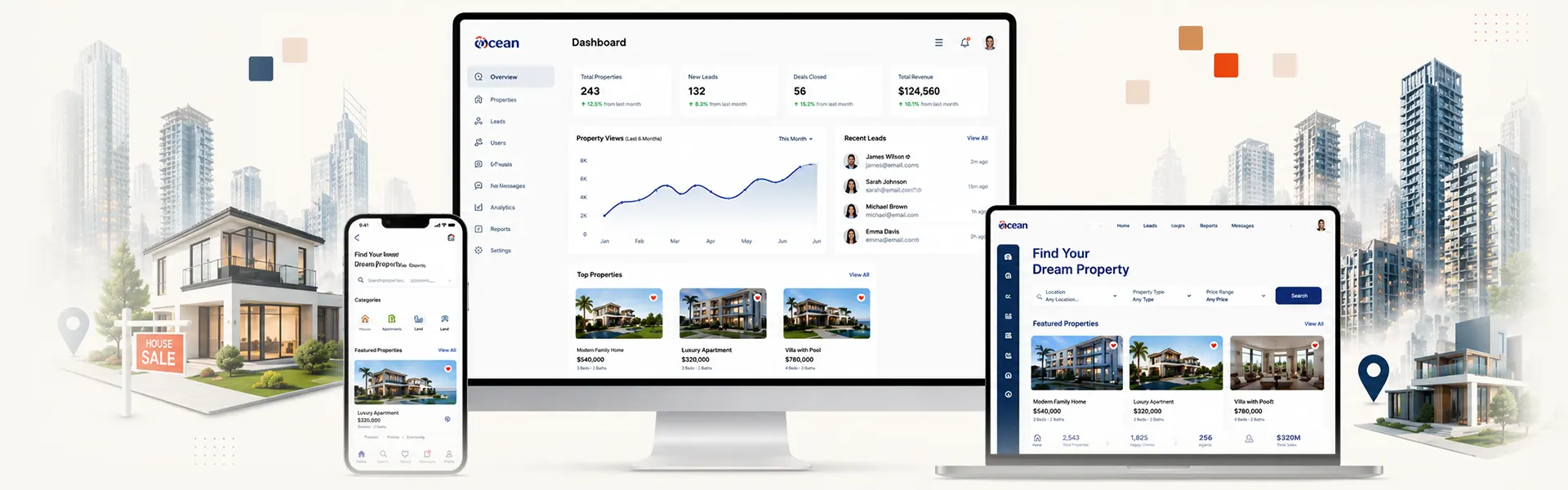

Technology for Real Estate

Real estate still runs on spreadsheets, WhatsApp threads, and software that was last updated when BlackBerrys were relevant. We build custom platforms, property management tools, and agent-facing systems for companies that have outgrown the workarounds and need technology that actually reflects how their business works.

REAL ESTATE CAPABILITIES

Built for how real estate actually works. Not how a software vendor thinks it does.

Real estate has its own data sources, its own transaction complexity, and its own version of "urgent." We've built across the full property stack, from agent tools to developer platforms to proptech products, and we know where generic software falls short.

Property Listing & Search Platforms

Property Listing & Search Platforms

Custom listing platforms that pull from MLS feeds, internal databases, and third-party sources. Built for search experiences that actually help buyers find the right property, not just any property that matches a filter.

Learn more


PLATFORMS WE WORK WITH

The data sources, integrations, and infrastructure real estate software depends on. We know them.

Real estate software connects to MLS feeds, mapping services, payment gateways, and document platforms. We've built those connections enough times to scope them accurately and build them so they stay reliable when your data changes.

MLS
MLS / IDX Integration
G
Google Maps & Places
D
DocuSign & E-signatures
$
Stripe & Payment Gateways
iOS
iOS & Android
Cloud
Cloud (AWS / Azure)

Our Process

Workflow mapping, stakeholder interviews, data source audit, and integration planning. We talk to the agents, the property managers, the ops team, and the leadership because they all have a different version of what the software needs to do.

Discover
ONBOARDING
DISCOVERY
Discover
ONBOARDING
DISCOVERY
WHY OCEAN

Six things real estate companies should expect from a software partner. Most don't get all of them.

We're not listing what we wish were true. These are the specific things real estate clients bring up when they explain why the engagement worked.

REASON 01

We start with your workflow, not a template.

Every real estate business runs differently. Before we write a line of code, we understand your pipeline, your team structure, and your data sources. The software is built around that, not adapted from something else.

REASON 03

Agents adopt tools that fit their day.

If the CRM takes longer to update than a WhatsApp message, agents won't use it. We design for speed, mobile-first, and the reality of someone who's always between meetings. Adoption isn't a training problem. It's a design one.

REASON 04

Migration is scoped and planned from day one.

Contacts, listings, transaction history, documents. We plan the data migration at the start of the project, not the end. Data gets cleaned, validated, and moved before go-live. Nothing gets lost in the switch.

REASON 05

Post-launch support through first busy period.

Real estate software shows its edge cases when deals are active and agents are under pressure. We stay on through that window, fix what real usage exposes, and make sure the system holds up when it matters.

REASON 06

Full ownership. Clean handoff.

Everything we build is yours: code, data models, integrations, documentation. No proprietary lock-in. Take it in-house, hand it to another vendor, or keep working with us. The choice stays with you.

COMMON QUESTIONS

Frequently Asked Questions

What makes real estate software different from other software projects?

Three things mainly. The data is messier, coming from MLS feeds that are inconsistent by nature. The users are harder to design for, because agents are time-pressed, opinionated, and quick to abandon tools that don't fit their day. And the workflows are more complex, because a real estate transaction involves more parties, more documents, and more steps than most software teams plan for.

How do you approach agent adoption?

We involve agents before we start designing, not after. Their feedback shapes the interface, the workflows, and the features that make the cut. A tool built around how agents actually work gets used. One built around assumptions doesn't. That's the difference between a successful rollout and an expensive CRM nobody opens.

How long do real estate software projects take?

Longer than clients usually expect, and for good reasons. Complex workflows, data migration, and agent-specific design requirements add time that generic software projects don't have. A focused tool: two to four months. A full brokerage or developer platform: four to eight months. We give you a real timeline in discovery.

Can you connect our platform to MLS and third-party data sources?

Yes. MLS and IDX integration is one of the most common things we build in real estate. We handle the data normalisation, the sync frequency, and the edge cases that come with feeds that update constantly and aren't always accurate. Your platform shows clean data. We manage the mess behind it.

Can you handle data migration from our current system?

Yes. We scope and plan the migration at the start of the project. Contacts, listings, transaction history, and documents. Everything gets cleaned and validated before it moves. The switch should feel like moving into a better place, not starting over with a blank system.

Do you build for property managers as well as agents and developers?

Yes. Property managers have different needs: tenant management, lease tracking, maintenance workflows, and financial reporting. We've built for all three sides of the real estate industry and know that what works for an agent doesn't work for a property manager. Different users, different design briefs, same quality of build.